
ブルーパブ用の醸造設備の選択には、バッチサイズの選択だけではありません。. システムはビールメニューに適合する必要があります, 生産スケジュール, 利用可能なスペースとローカルユーティリティ.
A small venue serving a few house beers may need a different configuration from a brewpub offering seasonal releases or supplying beer to other locations. Even businesses choosing the same brewhouse capacity can require different fermentation tanks and supporting equipment.
This guide explains what to consider before ordering brewpub brewing equipment—and what information to prepare for a useful quotation.
Start with Your Beer Sales and Brewing Schedule
Before choosing equipment capacity, estimate how much beer you expect to serve and how often your team can brew.
A 100L or 200L system may be considered for smaller production plans, while other projects may require 500L, 1000L or 2000L equipment. The appropriate choice depends on demand, staffing, available space and the brewing process.
Batch size alone does not determine monthly output. 発酵時間, tank availability, cleaning and production losses also affect how much finished beer you can sell.
Prepare an expected sales range, the number of beers you want on tap and a realistic weekly brewing schedule. These details give your supplier a clearer basis for recommending a configuration.
Also confirm what the quoted capacity represents: vessel total volume, working volume or wort output per batch.
Choose Fermentation Tanks Alongside the Brewhouse
The brewhouse produces wort, but fermentation tanks remain occupied while beer ferments and conditions. Both parts of the system should be planned together.
Consider how many beer styles you want to produce at the same time. Separate tanks offer flexibility for different recipes and production schedules. Larger tanks may suit beers brewed regularly in greater quantities.
One option is double-batch brewing, where two brewhouse batches are transferred into one larger fermentation tank.
例えば, a brewhouse producing approximately 500L of cooled wort per batch could be paired with a fermenter designed for approximately 1000L of working volume, with additional fermentation headspace.
This arrangement requires suitable brewing capacity, cooling and a coordinated fermentation process. 麦汁温度, batch timing, yeast management and hygiene must be planned with the brewer.
A larger fermenter can provide another configuration option, but it does not automatically solve every production limitation. Tank occupancy and the time available for brewing still matter.
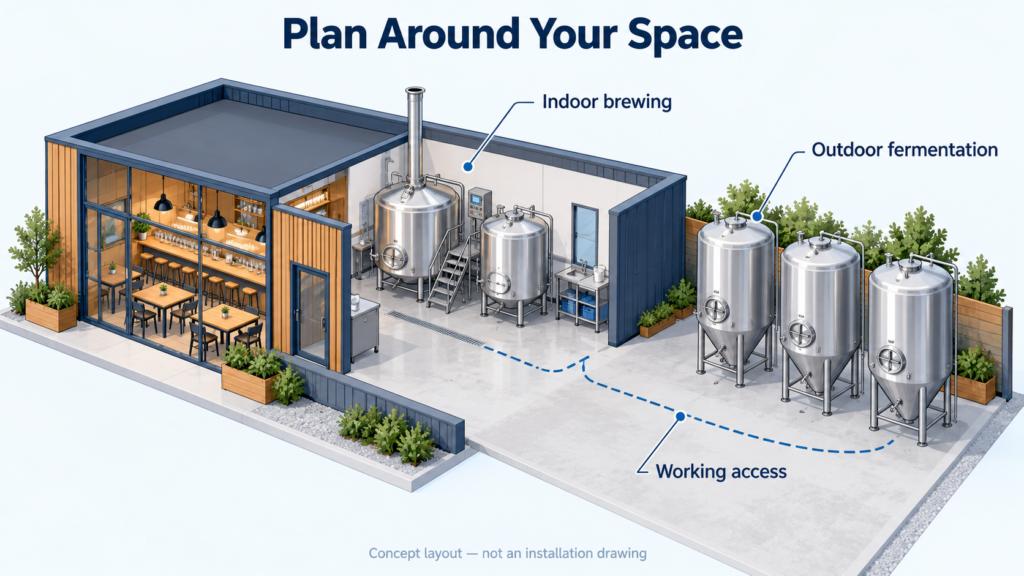
Plan the Equipment Around Your Available Space
A good brewery layout provides space for operation, cleaning and maintenance, as well as the equipment itself.
Before finalizing the layout, check:
- Room dimensions and ceiling height.
- Doorways and the equipment delivery route.
- Drainage and utility connection points.
- Access to valves, manways and control panels.
- Space for ingredients, kegs and cleaning equipment.
UNMAR can customize equipment dimensions and arrangements according to the site and production requirements. Depending on the project, this may involve adjusting vessel proportions, equipment positions or connection locations.
Customization should preserve practical working access and suitable process performance. A measured floor plan and photos of the proposed brewing area help identify these needs early.
Consider Outdoor Fermentation Tanks When Indoor Space Is Limited
Limited indoor space does not necessarily mean fermentation capacity must remain unchanged.
UNMAR has supplied fermentation tanks for outdoor installation. Where the site allows, an outdoor fermentation area can provide an alternative to placing every tank inside the brewpub.
The design needs to account for the local climate, 絶縁, 温度制御, weather exposure and pipe connections. Foundation requirements, maintenance access and local installation permissions should also be reviewed. Cold locations may require additional freeze protection.
Outdoor fermentation tanks should therefore be discussed during layout planning, with the installation environment included in the equipment specification.
Confirm Heating and Local Power Requirements
The heating arrangement should match both the brewing process and the utilities available at the site.
Confirm your local voltage, 頻度, single-phase or three-phase supply, and available electrical capacity. UNMAR can customize the equipment’s electrical configuration for the agreed local supply.
If the existing supply cannot support the proposed system, the equipment requirements and possible site upgrades should be reviewed together with a local electrician. Voltage matching and increasing the building’s available power are separate issues.
Confirming these conditions before production helps avoid unexpected installation changes.
Include Cooling, Cleaning and Beer Handling Equipment
A working brewery needs more than the brewhouse and fermentation tanks.
Depending on your process, the equipment plan may also include:
- Grain milling and malt handling.
- Hot water supply.
- Wort cooling and glycol cooling.
- Transfer pumps, hoses and fittings.
- Cleaning-in-place equipment.
- Kegs and keg washing or filling equipment.
- Bottle or can filling equipment.
Choose these items around how you will operate. A brewpub mainly serving beer on tap may have different priorities from a business selling packaged beer.
Ask which items are included in the quotation, which are optional and which must be prepared locally.
Compare the Full Equipment Configuration
Two quotations with the same stated brewing capacity may cover different equipment and services.
Review working volumes, heating arrangements, controls, cooling equipment, パンプス, valves and accessories. Confirm the proposed dimensions and electrical requirements.
Also ask what drawings, operating instructions, installation guidance, commissioning assistance and spare parts support are included.
A clear scope helps you compare quotations and plan the overall project budget, including transport and local installation work.
What to Prepare Before Requesting a Quote
You do not need to decide every technical detail before contacting a supplier. Start with:
- Your project location.
- Whether this is a new brewpub or an expansion.
- Expected beer sales and the number of beers on tap.
- Available space, ceiling height and site photos.
- Local power supply information.
- Your planned brewing schedule.
- Whether you will serve beer on tap, in kegs, bottles or cans.
- Your target opening date and approximate equipment budget, if available.
These details help turn a general price enquiry into a discussion about equipment that fits your business.
Planning a new brewpub or expanding your brewing capacity? Contact UNMAR with your floor plan, production plans and local utility information to discuss a suitable brewing equipment configuration.